Showing posts with label book of the day. Show all posts

Thursday, May 31, 2018

4 STARS Review by GabbiV -- Andalusian in Jerusalem


Review by GabbiV -- Andalusian in Jerusalem

Unread post by GabbiV » Yesterday, 17:46
[Following is a volunteer review of "Andalusian in Jerusalem" by Mois benarroch.]
Book Cover

4 out of 4 stars

Share This Review


Andalusian in Jerusalem is a work of fiction written by Mois Benarroch, which begins with the narrator’s complicated relationship with the word Jew. Exploring what that word meant personally and to others around him, the narrator’s tale is filled with runaway tangents and colorful embellishments. This book is more about appreciating the language used and not the conclusion to the overarching plot, as the author knows it’s all about the journey.

The narrator’s voice as he regaled his audience with his tale is rich and nuanced, filled with idiosyncrasies and catchphrases. This strong narration works with the (almost) seamless stream of consciousness style of writing, to faithfully recreate the singular effect of listening to a rambling elder who likes to both hear their own voice and impart knowledge to the youth.

The plot follows the narrator as he questions his identity with how others perceive him and how he thus defines himself. This is central to the book, with each reiteration and personal revelation, the narrator delves into a deeper understanding of himself.

I would recommend this book for the rich attention to detail, the amusing anecdotes that fill the narrator’s stories, the high quality and strength of the narrator’s voice, and how well it works with the stream of consciousness writing style. Due to the nature of the book, I think people who enjoy Virginia Woolf would be similarly pleased, even if some of the tangents get a bit long. I rate this 4 out of 4 stars for its deceptive simplicity and elegance of form. The text is self-aware to a degree, having the characters remark on various plot points as they are thus affected, creating room for a breath of levity when the fourth wall breaks.

This book will probably not be enjoyable to people who prefer action-packed plot-driven page-turners because of the slow pace and amount of text dedicated to “superfluous" information. Though the stream of conscious style is not employed throughout the book, it makes up a significant part of the text. On top of that, it takes a while for the plot to focus and pick up past its somewhat rambling start, where several topics of varying importance were discussed at various lengths. I also noticed that transitions between actions were quick or barely stated, catching me slightly off guard any time the characters took off in a new direction plot-wise.


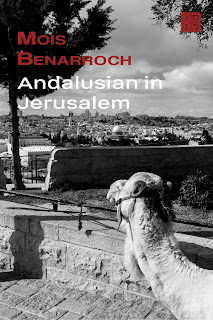
NEW COVER!


Tuesday, April 3, 2018

4/4 * review of "Andalusian in Jerusalem"

Review by Maggie G -- Andalusian in Jerusalem

Post by Maggie G » 04 Feb 2018, 21:49

buy book

4 out of 4 stars

Share This Review


Andalusian in Jerusalem, by Mois Benarroch and translated by Enriqueta Carrington, is a strange, destabilizing novel about a writer grappling with identity and memory.

The book opens with Guillermo, the narrator, recounting childhood memories, including one wherein he tells his classmates that he’s Jewish, although (to his knowledge) he isn’t.

The book then transitions to present day, where Guillermo is in Jerusalem for a writers’ festival. While walking through the streets of Jerusalem, Guillermo wanders into a woman’s home, and she tells him she’s his mother, that his name is actually David (which is Guillermo’s secret name for himself) and that he died in the Lebanon War. Guillermo suddenly leaves, telling the woman he will return the next day.

Guillermo then meets with his writer friends, Charly and Nora, and Charly tells a story that sounds a lot like Guillermo’s recent strange encounter with the woman. Upon leaving Charly and Nora, Guillermo is kidnapped by several men who show him a movie about water memory (which is explained later as a phenomenon whereby water remembers events, and thanks to this memory, one might even reproduce the underlying events). The kidnappers tell him the movie proves that they’re the owners of Jerusalem, and ask him to write about it. Guillermo agrees to try, and they return him to his hotel.

The next morning, Charly gives Guillermo a manuscript of a novel he’s written, and Guillermo agrees to read it. Guillermo then tries unsuccessfully to find the home of the woman who claimed to be his mother.

Guillermo reads Charly’s manuscript, which is a fluid, meandering work about the Jews of Spain, their forced conversions, which led to uncertainty about Jewish identity, and their expulsion from the region. Upon completing the manuscript, Guillermo searches again for his “mother’s” home. The ensuing events bring the reader back to the underlying themes of memory and identity.

There are two things I especially liked about this book. The first is the sophisticated way the author dealt with the themes of memory and identity that appear throughout the book. Too frequently authors treat thematic elements with a heavy hand, and tell rather than show. In this case, a lot of things are left unsaid, and I think it takes a great deal of discipline on the part of the author to trust the reader to follow along.

The second aspect of the novel that I enjoyed was its matter-of-fact recounting of strange events. The plot summary makes the book sound like science fiction, because there are definitely elements of the supernatural, but the characters wave off these event, attributing them to the city and explaining that these kinds of things happen in Jerusalem. Because of the characters’ reactions to the supernatural events, the novel has an element of magical realism.

There were a few aspects of the novel that I found problematic. The portion of the book that consists of Charly’s manuscript is too long. This section is necessary to support the themes of identity and memory, but partway through I found myself unsettled and felt as though I’d been abandoned by the narrator. This could be remedied by breaking the narrator’s reading of the manuscript into two parts, with a brief return to the main story halfway through. The manuscript also included quite a lot of poetry, which I began to find a little tiresome.

I also found myself reacting to the book in a very unemotional way. I did not care at all about the narrator—he was not likeable, nor even especially well developed. Strangely, I was much more moved by the characters and the stories in Charly’s manuscript.

Another small complaint: Charly’s manuscript delves into certain aspects of the history of Sephardi Jews. This was fascinating, but not something I was familiar with. Because this history plays such a large role in the themes that the novel explores, it might be beneficial to include a short note at the beginning of the novel to give the reader a brief background.

This is a short book, but not a page-turner. It is, however, very fluid, so it’s not a difficult read. I would recommend this novel for readers who enjoy literary fiction, and it would be an excellent choice for a book club—shorter books are more likely to get read, and there would be plenty to discuss.

I found several typos, so the book would benefit from an additional reading by an editor. However, because the errors weren’t pervasive, and because its shortcomings are outweighed by its unusual sophistication, I rated Andalusian in Jerusalem 4 out of 4 stars.


read ANDALUSIAN IN JERUSALEM in

4/4 stars Review by Amelia Andrews -- Andalusian in Jerusalem


read ANDALUSIAN IN JERUSALEM in
Italian https://www.amazon.it/dp/1507163495
Page:onlinebookclub.org/reviews/by-ameliaandrews.html
Latest Review: "Andalusian in Jerusalem" by Mois benarroch

Review by Amelia Andrews -- Andalusian in Jerusalem

Post by AmeliaAndrews » 27 Jan 2018, 10:40
[Following is a volunteer review of "Andalusian in Jerusalem" by Mois benarroch.]
Book Cover

4 out of 4 stars

Share This Review


Mois Benarroch's Andalusian in Jerusalem recounts the story of a Spanish writer's adventures in Israel, all the while, pretending to be a Jew and having made a career of writing about Jewish history.

Stylistically, the book is superb, the vivid descriptions and sparse, literal inner monologue of the main character contrasting wonderfully with the absurd and often nightmarish events which take place. The stony acceptance with which these events are met highlights the absurdity of human interactions and the chaotic, meaningless nature of the world, mirroring Kafka - one of the main character's literary inspirations - thematically as well as stylistically.

A related theme of the book is the disparity between appearance and reality. This idea is emphasised throughout the book, set in a city where streets cease to exist for hours or months at a time, characters age decades in the space of minutes and the main character assumes both a fictional identity and a fictional family. One interpretation is that the nature of reality is not fixed or determined and can be changed at will, seen when Guillermo assumes, without evidence, that a certain house exists only at night and is proved to be correct. The notion of a reality determined solely by our actions and interpretations perfectly mirrors Sartre's radical freedom.

Similarly, the theme of personal identity is also key to the book, with the main character adopting a Jewish identity and then another persona entirely, as well as others struggling with personal identity in the face of societal pressures to conform, such as Charly and his characters. This idea is expanded in Charly's manuscript, detailing the stories of forced conversions as well as the search for personal identity in an antagonistic society. One of the important idea which arises is whether identity can be found in the past, through one's cultural heritage and ancestry, or in our present lives and through future children. Perhaps the endless returning to the legacy of the dead is an attempt to find meaning in an otherwise meaningless world, indifferent to human purposes. Another interpretation is that the cultivation of the past into an identity is an attempt to reconcile pain, particularly prominent in the tales of religious persecution described in the story.

A final point of interest is the commentary of characters, who are writers, on the nature of a writer's duty. This is a profound discussion, offering the perspective that writing is of such importance that it should take precedence over all other pursuits, Charly telling Guillermo that being a writer is more important than an editor and that 'true' writers are hard to come by. In this mindset, literature is valuable because it provides some connection to knowledge and truth, which is regarded as inherently valuable.

In conclusion, this book is exceptionally well-written, a thrilling adventure and insight into a great mind, recommended to anyone interested in Spanish or Jewish culture, writing as profession or existentialist themes. It makes for an extremely sophisticated and at times surreal read, echoing the literary styles of Franz Kafka, as well as exploring some of his favoured themes, engaging and exceptional in parts and thus deserving of a rating of 4 out of 4 stars.

******
Andalusian in Jerusalem 

4/4 stars ANDALUSIAN IN JERUSALEM by Mois Benarroch

Review by AmeliaAndrews -- Andalusian in Jerusalem

Post by AmeliaAndrews » 27 Jan 2018, 10:40
ANDALUSIAN IN JERUSALEM

4 out of 4 stars

Share This Review


Mois Benarroch's Andalusian in Jerusalem recounts the story of a Spanish writer's adventures in Israel, all the while, pretending to be a Jew and having made a career of writing about Jewish history.

Stylistically, the book is superb, the vivid descriptions and sparse, literal inner monologue of the main character contrasting wonderfully with the absurd and often nightmarish events which take place. The stony acceptance with which these events are met highlights the absurdity of human interactions and the chaotic, meaningless nature of the world, mirroring Kafka - one of the main character's literary inspirations - thematically as well as stylistically.

A related theme of the book is the disparity between appearance and reality. This idea is emphasized throughout the book, set in a city where streets cease to exist for hours or months at a time, characters age decades in the space of minutes and the main character assumes both a fictional identity and a fictional family. One interpretation is that the nature of reality is not fixed or determined and can be changed at will, seen when Guillermo assumes, without evidence, that a certain house exists only at night and is proved to be correct. The notion of a reality determined solely by our actions and interpretations perfectly mirrors Sartre's radical freedom.

Similarly, the theme of personal identity is also key to the book, with the main character adopting a Jewish identity and then another persona entirely, as well as others struggling with personal identity in the face of societal pressures to conform, such as Charly and his characters. This idea is expanded in Charly's manuscript, detailing the stories of forced conversions as well as the search for personal identity in an antagonistic society. One of the important idea which arises is whether identity can be found in the past, through one's cultural heritage and ancestry, or in our present lives and through future children. Perhaps the endless returning to the legacy of the dead is an attempt to find meaning in an otherwise meaningless world, indifferent to human purposes. Another interpretation is that the cultivation of the past into an identity is an attempt to reconcile pain, particularly prominent in the tales of religious persecution described in the story.

A final point of interest is the commentary of characters, who are writers, on the nature of a writer's duty. This is a profound discussion, offering the perspective that writing is of such importance that it should take precedence over all other pursuits, Charly telling Guillermo that being a writer is more important than an editor and that 'true' writers are hard to come by. In this mindset, literature is valuable because it provides some connection to knowledge and truth, which is regarded as inherently valuable.

In conclusion, this book is exceptionally well-written, a thrilling adventure and insight into a great mind, recommended to anyone interested in Spanish or Jewish culture, writing as profession or existentialist themes. It makes for an extremely sophisticated and at times surreal read, echoing the literary styles of Franz Kafka, as well as exploring some of his favoured themes, engaging and exceptional in parts and thus deserving of a rating of 4 out of 4 stars.


Monday, April 2, 2018

Review of -- "Raquel Says (Something Entirely Unexpected)" by Mois benarroch

Review by MTReader91 -- "Raquel Says (Something Entirely Unexpected)" by Mois benarroch

Post Number:#1 by MTReader91 » 08 Jun 2017, 03:11
[Following is a volunteer review of "Raquel Says (Something Entirely Unexpected)" by Mois benarroch.]

Book Cover

A Review of Raquel Says (Something Entirely Unexpected) by Mois Benarroch

Legend says somewhere exists a person in the world is living a life parallel to ours; someone who feels the same and possibly doing the same thing at this moment. The question is, what happens when two parallel line intersect?. The impossible happens; and what should not happen, happens. What if soul mates do exist, does that mean the meeting with our soul mate make our lives easier or gives us solutions? The narrator reveals his encounter with his soul mate, Raquel. Through him, we discover how these two people born in the same city, almost the same day, marry similar people, give their children the same names, and write almost identical books, without ever meeting each other before the age of forty. This book is an existential cataclysm, where this experience serves to drive these two characters further into exile. The book tests the limits of logic.

I rate this 3 out of 4. This book is truly a three on the scale because it reads better than other books I have read from the same author. The reason it can’t be a 4 is there are minor editing errors and minimal spellings questions. This book is the best one I’ve read by this author.

The story appealed to me because the other books I have read by the same author refer to a connection between several of his books. My curiosity of how the books connect allows me to pick this one. I did not find a connection to the other two books I’ve read, but there are 7 books within the connection according to the author. The transitions were better in this work than the two other works.

This novel could appeal to others because it tests the boundaries of human understanding. The main plot of meeting with your parallel self makes you question your understand of people and coincidence. The appeal of the story makes readers realize there might be something supernatural going on in the world.

I liked the main theme of having a person similar to yourself in a parallel universe. Also, the story also says you shouldn't meet your parallel mate because it may destroy what you have. The last part of the last chapter switches to being written by his parallel mate, Raquel, which makes the story more realistic. Overall, this book is my favorite by this author.


******
Raquel Says (Something Entirely Unexpected) 
View: on Bookshelves | on Amazon

Review by juliusotinyo -- Gates to Tangier

Review by juliusotinyo -- Gates to Tangier

Post Number:#1 by juliusotinyo » 20 Jun 2017, 13:15
[Following is a volunteer review of "Gates to Tangier" by Mois Benarroch.]

Book Cover

3 out of 4 stars

Review by juliusotinyo

Share This Review


Gates to tangier, by Mois Benarroch.

The story revolves around siblings of a Sephardic Jewish family initially based in Morocco but due to immigration different family members are now living in Paris, Madrid, New York and Jerusalem. From the onset the book presents you with their challenges beginning with the loss of their father and the shock of the impending quest he leaves on his will, a quest to find their secret half brother in Morocco. As they begin the quest their individual personal conflicts play out mainly on family life, marriage, immigration and integration in their settled lands. The story is about family ties, dealing with loss, Zionism and immigration from a Sephardic Jewish point.

After the death of the Benzimra's family patriarch, four siblings; Isaque, Messod, Silvia and Alberto reluctantly depart for Tétouan Morocco to find their secret half brother Yosef. Who is the illegitimate child their father had with a former maid in Morocco, and had been kept a secret till his death. They are obligated to do so as a prerequisite to unlock their inheritance before 5 years of their father's death. Messod, Sylvia and Alberto meet up with their brother Isaque at Barajas airport, where ironically each sibling in their own way see or picture their dead brother Israel wandering about in the airport. I would say in their unity to find a secret brother they remember a brother they truly lost. The journey will take them through Malaga all the way to their destination in Tétouan and finally to Chauoen Morocco. What they find and its underlying mystery is a nice blend of thrilling suspense and scandal, fit for a good read.

The Author's use of monologue from each of the main characters captured their thoughts and feelings nicely giving them a personal feel; making you part of the story, something that I enjoyed a lot. However, it was hard at times to follow especially when the author used unfamiliar Hebrew/Jewish terms which forced me to look them up before continuing. The author also paid too much attention to the personal conflicts of the 4 siblings and less on the actual half brother, hopefully meant for a sequel I hope. Though I still welcome the twist in the end and overall liked the story.

I'd recommend this book to anyone interested in Jewish history and not for those who don't. Also the Sephardic-Ashkenazi rift plays out a lot and especially through Alberto Benzimra. Though not entirely negative, it is being described through a Sephardic Jew and anyone with sensibilities on the subject may take offence.

I rate this book 3 out of 4 stars!

There were several grammar errors, specifically an excessive use of hyphenated words like sic-k, of-ten where inappropriate and I'd also recommend use of a glossary to explain unfamiliar terms, is why I'd not give it a 4. I'd not rate it a 2 because I enjoyed the story and really connected with the characters enough to look for the sequel.

******
Gates to Tangier 


Read Gates to Tangier in


View: on Bookshelves | on Amazon | on iTunes

Tuesday, January 16, 2018

Review -- The Expelled by Mois Benarroch

Review by Sgatev23 -- The Expelled by Mois Benarroch


Book Cover


Mois Benarroch, an award-winning poet and novelist (Amichai Prize, Prime Minister Prize), is an author of more than twenty books. His short novel, The Expelled, is part of a compendium of seven novels under the name Amor y Exilios (Love and Exile).

This remarkable novella relates the story of a writer who falls in love with a young woman, Gabrielle, whose name and appearance are exactly like his wife’s, only she is twenty-five years younger. A question arises whether they are the same person or not. The mysterious event shapes a narrative which reveals vivid features immanent to magic realism, or, more accurately, to metafiction, genres that reject any of the conventional rules imposed by traditional modernism. It is not long before the reader is forced to consider the story not only as a creative product but as a creative process. As the unnamed writer admits:

“It could very well be the pure imagination of a writer, an idea to write a novel or a story, although I am not very good at writing short stories, I need more words. It must have been just that, one should not play with coincidences or imagination.”

The overt romance, then, quickly fades away when both characters enter the fictive world of the writer-protagonist’s short novel. There, the kidnapping of a bus slowly shapes itself into an allegory of the problematic relationship between Sephardic and Ashkenazi Jews. The bus is separated between the ‘back’ people and the ‘front’ people, and those adjectives, at first only terms used for better accuracy, soon become vividly emblematic of social classes and ethnic groups. In the aftermath of this event, while the central plot is seeking to find out who gunned down Cash, one of the ‘back’ people in the bus, the passengers recount their individual stories about that time when they were all together “between two seas, two worlds.” But whom to?

The self-reflexivity of the novel becomes ever more apparent when the main protagonist’s soliloquy is interrupted by his mysterious interrogators.

“Well, I see that in here I'm going to be talking alone and nobody is going to respond to anything. I don't even know if you're listening, maybe you've fallen asleep, or there's just one of you, or you're recording this and then you'll listen to only parts of what I say.”

This narrative bifurcation befuddles the reader as he sinks deeper and deeper into these metafictional layers and, at the same time, is invited by the very character to take his active role in interpreting the events (“… if I write our encounter one day it'll be a story in which someone tells a story about someone who's telling a story.”).

The Expelled is one of those literary gems with quantum-like properties which deem any genre categorization impossible. Apart from some minor editorial imperfections, a solid 3 out of 4 is what any perceptive reader would rate this brilliant piece of writing. Benarroch’s flouted play with fiction and reality gains him a well-deserved place right next to Wells, Fowles, and Borges.

******
The Expelled 
View: on Bookshelves | on Amazon | on iTunes


Read THE EXPELLED/ EL EXPULSADO IN
FRANCAIS   getbook.at/lExpulse
Italiano  getbook.at/lEspulso